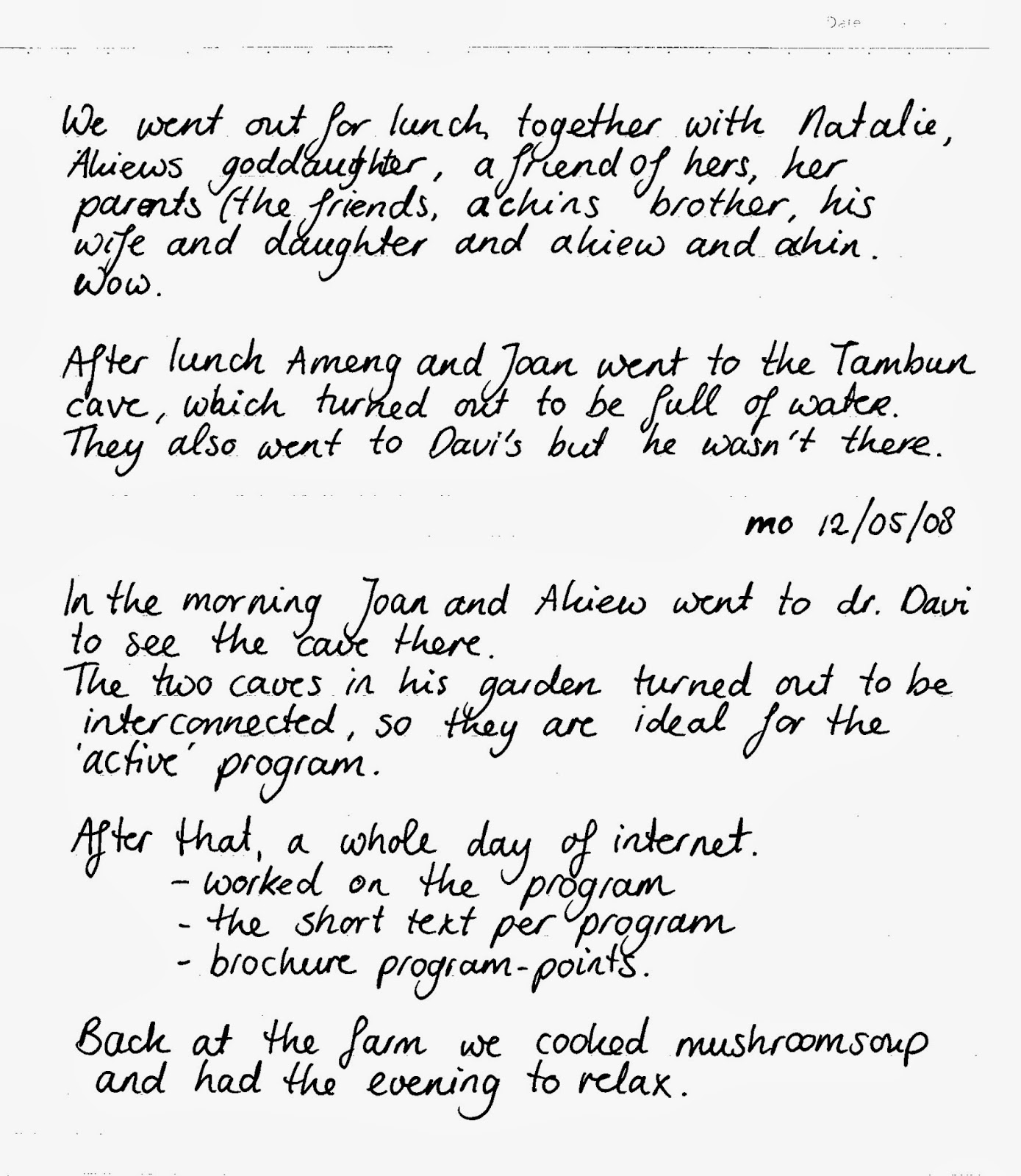
Monday, February 24, 2014

Possible Activities

Tour on the farm:
The Chin’s have been doing this for some time already. It’s very interesting and people can learn a lot from it. It would be nice to add fruit tasting to the tour, possibly something made with the recipes Michael will provide.

To do: Think of some recipes to use the fruits in (Michael)
Possible: Make a tour for children, something like a puzzle walk.
Possible: Make a brochure, or an A4 paper to give the visitors to take home.
Possible: Make laminated fruit guide, with names and uses of the fruits to take during the tour.
(On the other hand, this could take the attention of the farmer and the nature guide)

Time: 1.5 hours


Temple:
The Tung Wah Tong temple is a cave temple 10 min. from the Chin farm 157 Steps up, great view over the countryside, lots of statues and stalactites and a small cave behind the great hall. This cave is very small and not really interesting, although there might be a path leading from this cave to a complex of tunnels that were previously used by the communists.

On the other side of the cave stairs lead up to a plateau overlooking the surrounding mountains. It’s not possible to get there without going through the cave, so it couldn’t be the start or end of a walk, but it is a great place to have lunch. The temple has kitchen facilities and there a some chairs and a table on the plateau.

To do: Send a letter to the committee, so they can decide whether they want to join the project.
If they join: clean up the area behind the main hall (sweep)
Make sure there are enough chairs to have lunch with the tourists

Time: 45 min (without lunch)


Walking route to Amengs farm:
On the road from the polo club to Amengs farm. Beautiful route, easy to walk.

To do: Write down the route
Write down some information on the plant, rock formations, and animals along the route

Time: 1.5 to 2 hours


Trekking from Amengs farm to the other temple:
Very nice trek could be a bit too difficult for some people, so maybe only include this in an active package. On the side of the farm you have to pass through another orchard, which belongs to a friend of Ameng. On the other side, near the temple, it looks like a private property as well. There are also a lot of dogs around on that side.

To do: Find out whose land we’ll be walking on.
Clear the route, maybe together with the MNS?
Put some ropes on slippery slopes, bridges over ditches
How about the high route between the rock formations?

Time: 1 to 1.5 hours


Dairy Farm:
This place is one of the main attractions. Sagreet is a third generation farmer, and has around 80 cows on his farm, and goats as well. He produces milk in a traditional manner, milking the cows with his own hands. He is willing to join the program as an attraction, and also thinking about using his spare room as part of the homestay project. Sagreet has received a letter explaining a bit more about the project and Ehomemakers.

Time: 30-40 minutes


BBQ & Night walk at Amengs farm:
The farm is a very beautiful place to have a barbecue. Since there is no fridge on the farm, the menu will be fresh fish from the fishpond and vegetables. We will make a standardized menu so the guide doesn’t have to go through much trouble. After the barbecue, the tour guide will take the tourists on a short walk, point out some stars, constellations, fireflies, blooming flowers of the dragon fruit, frogs and other animals, listen to jungle sounds, etc. It could be interesting to have a map of the sky handy, so the tourists can look for constellations themselves.

To do: Make a simple fish and veggies menu
Find a map of the stars/constellations
The guide needs an assistant to help cooking and do the dishes. The tourists may not help and the job is too big for one person.

Time: The whole evening


Traditional games/storytelling:
This is one of Neal’s ideas. Basically the guide would improvise this part of the tour during the evening when there is not so much to do. For example: after the night walk, while tourists are sitting around the fire.


Davi:
At this doctor’s house there are several activities. First, Davi will explain about the different forms of alternative medicine he has been practicing for the last 8 years (see business card). Then, his wife can take the tourists on a tour in the garden, which is nice and has a lot of different plants and herbs. In the back of the garden are two caves that are linked. This place could be nice for caving and could be put into the active package (B). Otherwise, this is a good cave to show tourists that are not in the active program and explain about the way caves are formed. There are bats in the caves and monkeys in the jungle garden. The family is also thinking about using his spare room as part of the homestay project. Davi’s wife has received a letter explaining a bit more about the project and Ehomemakers.

To do: Think about having Davi as a homestay host. He is not a farmer and doesn’t seem to need the money, so is he suitable as a host?

Time: Talk and garden tour: 45 min
Caving: 30 min


Orchid Farm:
Nice place to take visitors. The owner is very helpful and knows a lot about the orchids. Very close to the dairy farm. Mr. Wong is interested in receiving visitors and we have given him a letter explaining a bit more about the project and Ehomemakers. The owner of the land also agrees with the whole plan and could show the tourists him orchard.

Time: 20 minutes


Tambun cave:
A good place to take tourists. There is no actual cave, the drawings a on a big rock wall. Both the well and the drawings are worth a visit. The only drawback is the ‘getting there and away’ bit, the land is owned by some rich polo playing guy. We don’t have a name or a number, but he’s there every morning and evening practicing.

To do: Find out who owns the land and ask for permission to cross once in a while with some tourists.

Time: 10 min to walk there, 15 to see the paintings


Old mining area:
About 30 min. Drive from Tambun, but really amazing. Big piece of mature, accessible to everyone. Lily ponds, many birds nesting there, easy roads to walk.

To do: Find a map of the area, or a satellite photo
Make sure the guides know the area and know various walks
Some of the optional picnic spots are a bit messy; make sure the guides clean them up a bit before taking tourists there

Time: 30 min drive, hours to walk around


Cooking course:
Michael and Diana will be working on this


Other Activities

Plant nursery:
Not checked yet.

Pottery factory:
Not checked yet.

Batik factory:Not checked yet.


Dismissed Activities

Herbs Farm: XXX
The owner we met, Mr. Wong, didn’t know a lot about herbs. He says his partner knows more about them, but apparently this partner is not always around. The place is also really small and not as impressive as Dr. Davi’s herb jungle.

Fishing or boating on the pond at Amengs farm: XXX
Doesn’t appeal. The pond is too small to put a boat in, unless you’re talking about children. Fishing isn’t very interesting because you’ll catch a fish within a minute.

Cave behind the Tibetan temple: XXX
Too dangerous to find the entrance, not possible to take tourists there. Apart from that, it seems like the temple has other plans for the cave. Inside there are big wooden structures for the collection of birds’ nests. The temple itself is not interesting enough, and it’s not very ECO.

Host spring/waterfall: XXX
We haven’t found one so far, but maybe one of the trips with MNS or the Senior Citizens Club will be fruitful.

Kellie’s Castle: XXXIs already a tourist attraction, and commercial. So it won’t be included in the program. We can refer to this attraction on the website.

Wooden shoe factory: XXX
The owner is not interested in joining the project.

Bean Curd factory: XXX
The owner is not interested in joining the project.

Very interesting factory, a bit out of the way, but still near Tambun. The scooping and drying of the bean curd is done all day, but the grinding of the beans and the separating of the soya milk from the beans is only done in the morning. We think the tourists should see the whole process, starting with beans and ending with beans curd, so we should have someone around to turn on the machines and show them. The place needs a lot of cleaning.

Normal shoe factory: XXX
This is considered cottage industry. For the packages as they are right now, this factory is too far away and not interesting enough. Peck Lin will keep it in mind and maybe use it in another package based on cottage industry around Tambun.


Nightwalk

After dark, it is nice to give the tourists a short tour of the farm ‘by night’. Below are some idea’s, remember that for someone not used to the jungle, almost everything is interesting. The walk can take anywhere between 15 minutes and hour.

Flowers of the Dragon fruit:
The flowers of the Dragon fruit only bloom at night, which makes them very special. The white flowers are large and fragrant and they have the typical cactus flower shape. Nicknames for the flower are Moonflower or Queen of the Night.

Fireflies:
Although there are far less fireflies here than there are in some other places in Malaysia, they are still fascinating to many tourists. Below some facts about fireflies are listed:
  • Light production in fireflies is due to a chemical reaction that occurs in specialized light-emitting organs, usually on the lower abdomen.
  • The firefly most common to Malaysia’s peninsula is the Pteroptyx. This kind of tropical firefly routinely synchronizes its flashes among large groups, a startling example of spontaneous biological order.
  • Female Postures fireflies are known for mimicking the mating flashes of other fireflies for the sole purpose of predation. Target males are attracted to what appears to be a suitable mate, and are then eaten. For this reason the Postures female is sometimes referred to as “femme fatale”.
  •  Adult fireflies live for a few weeks.
  • The ancient Chinese sometimes captured fireflies in transparent or semi-transparent containers and used them as (short-term) lanterns.
  •  In Mayan mythology, fireflies were said to contain the light of the stars.

Look for frogs:
You could follow the river for the short way; see if you can find frogs. Show the tourists how to stun a frog in the light of your flashlight, maybe show them how to catch one.

Listen to the jungle
The sounds of the jungle are very different from the sounds most tourists know. So let everyone turn of their flashlights and listen to the cicadas, frogs and night birds.

Stars:
Have a look at the stars. So far out of the city, they are much brighter than usual. And they are different from the stars we see on the northern side of the globe. The big dipper, for example, is turned upside down. It could be nice to have a map of the constellations at hand.

Volunteers Blog


Sunday, January 12, 2014

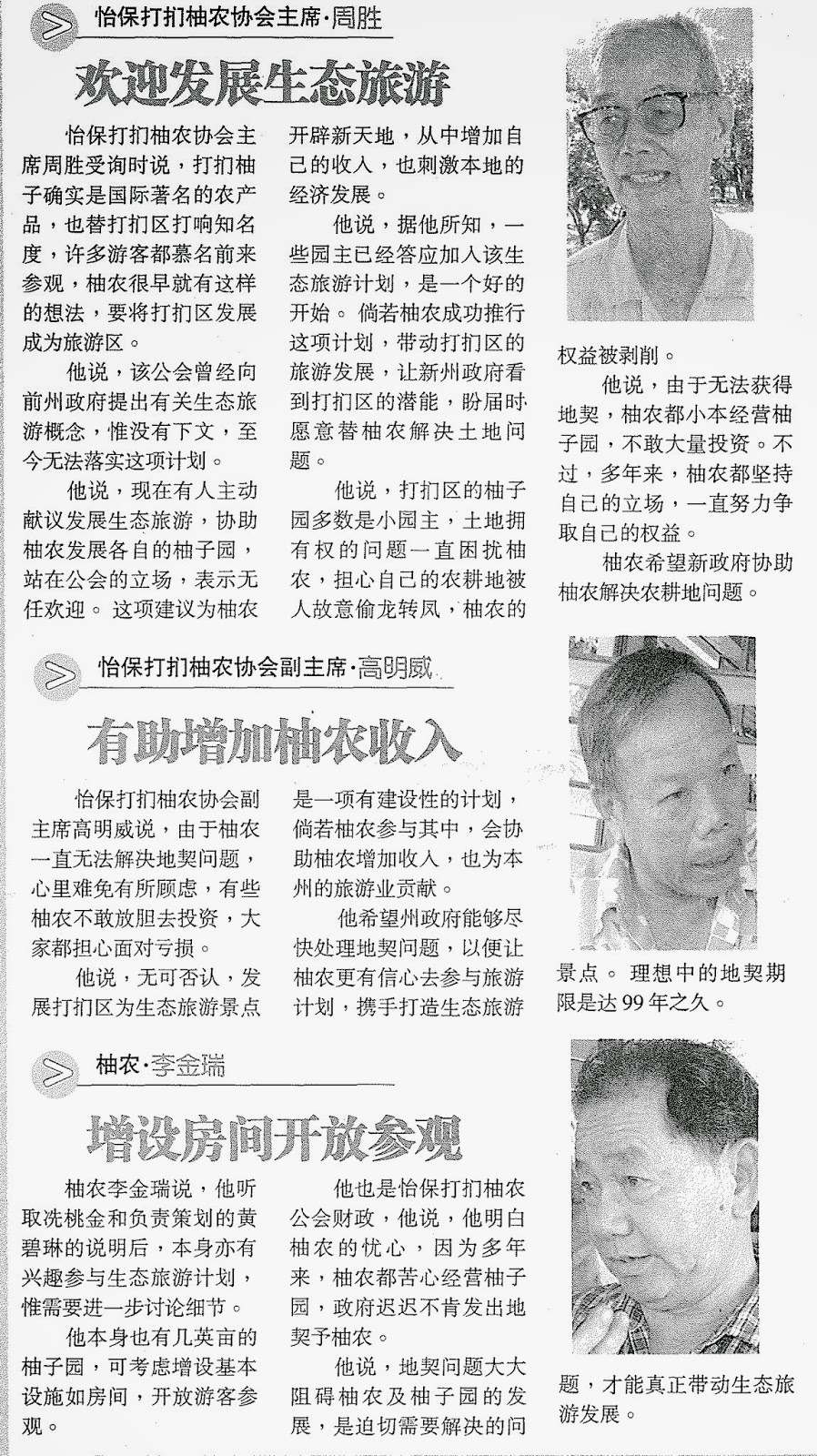
打扪之旅---第一篇

打扪发展生态旅游

来源:南洋商报,30-07-2008


打扪之旅---第三篇

打造生态旅游遇阻!

来源:南洋商报,01-08-2008


一旦发展成生态旅游,游客将陆续而来,
柚子园须有完善的基本设施。

为了营造与大自然为伴的感觉,
设立高脚亚答屋成为首选。


打扪之旅---第二篇

参与生态旅游计划

来源:南洋商报,31-07-2008


游客在果园品尝榴莲,别有风味


From ‘Hairy Fruit Cape’ To Tambun Temples

Source: The Star, 11,November 2007

After discovering fascinating titbits, of the historical and edible kind, in Chemor last week, we continue our Kinta Valley journey and encounter Perak’s magnificent natural heritage. 
THE small towns around Ipoh are like huge, three-dimensional history books of stone and wood, holding intriguing stories of how this nation came about.  
On a “discovery trail” organised by the Perak Heritage Society (PHS), we move southwards from the charms of Chemor to look for clues to the past at Tanjung Rambutan.  
What a name. Was there ever a cape (tanjung) on a river bend with lots of hairy rambutan fruit trees in the far off mists of time?  


The unique Pencil Rock is now privatised into the Lost World of Tambun theme park.There are no records of this, but by 1892 Tanjung Rambutan was bustling with tin mines, notes Khoo Salma Nasution and Abdur-Razzaq Lubis in Kinta Valley: Pioneering Malaysia’s Modern Development (Areca Books).  
A British expedition going up the “Ulu Sungei Suntu” (Upper Suntu River) en route to the second highest mountain of Peninsular Malaysia, Gunung Korbu, found Malay and Chinese miners “working together amicably” at this Cape of Hairy Fruits.  
In the old days, elephants were used to transport tin and provisions between the cape and Ipoh but they were soon supplanted by “more efficient” bullock carts. Then, in 1897, the trains arrived.  
“A hundred years ago, Chinese squatter vegetable farmers around here used the railways to sell their produce all over Malaya. The landscape north of town is just like it was then,” says PHS president Law Siak Hong, during one of the many briefing sessions during the trip.  


They built them to last in those days: the Tanjung Rambutan train station is still standing after 110 years.Around here too, lies Rumah Changkat Kinding, a former estate manager’s bungalow built to oversee a small tea plantation. The tea is long gone but an old advertisement, reproduced in Kinta Valley, captures the times with the urge to “Buy British, Think Malayan, Drink Perak Tea”.  
“This house was rented by the production designers of (the movie) Anna and the King when they were filming in Perak,” recalls Law.  
Going into Tanjung Rambutan town, Law makes us look for old street names. The main Caulfield Road, named after a colonial-era British engineer, has since been renamed Jalan Majlis.  
The Sunday pasar minggu (weekly market), complete with snake charmers, is in full swing.  

The Kinta Valley book reproduces this ad from the early 20th century hawking tea produced at Changkat Kinding Estate just outside Tanjung Rambutan.“It’s been like this for the past 100 years, people coming to buy, sell and watch,” says Law. 
Another landmark here is the Tat Choi (Attain Abilities) Chinese school, which was established by the local Philomatic Union (reading club). On one sign, the year 1929 is commemorated as the 18th year of the da chung hua min guo, or the Republic of China, established in 1911 by Dr Sun Yat Sen.  
“There were many supporters of Dr Sun Yat Sen among the people here. They helped set up this school,” recounts Law, adding that, “In Taiwan today, they still mark years starting from 1911.”  
Of course, Tanjung Rambutan is infamous for its mental hospital, established in 1911 as the Federal Lunatic Asylum.  
“The trip won’t go into the hospital, as this is not a circus sideshow,” says Law. “But people can go in by themselves.” 
According to Landmarks of Perak (RNS Publications), a book commissioned by the state’s Raja Muda, Raja Nazrin Shah, most of the original buildings are still intact. This includes the pharmacy, a single-storey timber building generously shaded on all sides by bumbung Perak (Perak roof) supported by timber posts.  
Some wards are built in a kebun (garden) arrangement with half-wooden chalets laid out among orchards, farms and fishponds.  
“With slight adaptation, these buildings would not be out of place at a budget holiday resort,” notes Landmarks of Perak.  
Perhaps this salubrious setting led to the place being renamed Hospital Bahagia (Happy Hospital) in the early 1970s.  
The Tat Choi Chinese school bears a sign for the year 1929, the 18th year of the Republic of China established in 1911 by Dr Sun Yat Sen.


Natural heritage 
Tambun used to have tin mines and coffee plantations. Nowadays, it's more renowned for its natural heritage of spectacular limestone formations and, of course, its pomelos.  
Before the hot springs here were commercially developed, there were fields of hot water giving off steam that added to the mystique of the craggy outcrops. 
“Every community has stories of sightings of spirits here. The fifth Datuk Panglima Kinta (Lord of Kinta) was said to have disappeared here,” explains Law. 
This happened, it seems, after one of the lord’s companions “heard” merry-making in the hills.  
Today, much of the area has been cordoned off by a private corporation to form a gated community and the Lost World of Tambun theme park. Included in the grounds is the amazing Pencil Rock.  
“This unique rock formation was created by centuries of erosion. It’s very rare. The other famous one is on James Bond Island near Phuket (off Thailand),” explains Stephen Yaw, the theme park’s sales manager.  
“It’s a beautiful area. The homes used to sell for half a million ringgit. Now they are worth double that,” he adds.  
Only in Malaysia: at the muhibbah Tong Wah Tong cave temple, staff are proud of their ‘Lord Ganesha’, a natural limestone formation that supposedly resembles the Hindu deity. – SAIFUL BAHRI / The Star


“Last time, people could just walk in to see all this for free. Today, we are lucky to enter thanks to having Stephen here,” says Law.  
This prompts another trip participant, retired hotel manager Peter Bucher, to bring up a matter of principle: “Nature should belong to the public and not be fenced off by a developer. Unless the developer built the caves.” 
Still, uninhibited access has caused some damage to another heritage site near here, the Stone Age paintings of the Tambun Cave.  
“Groups have just gone in and trampled the ancient shells (the remnants of Stone Age dinners!) into powder,” notes Law.  
So, should access be controlled? By the Government or the private sector?  
Before we can debate that, we move on to other caves, some of which have become temples, such as the nearby Nam Loong Koo Miew.  
“This is the last cave temple around Ipoh with a timber facade. There are plans to demolish it and replace it with a fancy concrete structure,” says Law. 
“The temple used to be Taoist but nowadays it is more oriented to Buddhism, especially the Tibetan kind. This is a trend at other Perak temples too. 
“In Gopeng, for instance, I have heard how some old aunties are upset they can’t bring chicken and pork into the temple anymore as Buddhist temples are vegetarian.” 
However, the Tong Wah Tong cave temple next door is still Taoist, and offers a fascinatingly eclectic mix of gods. 
In fact, it is so muhibbah (racially harmonious) that its staff even point out a natural limestone formation that looks like the Hindu deity, Lord Ganesha.  
Maybe heritage holds some important lessons for all of us after all....